The Honest State of AI in GTM
I've been building AI into go-to-market operations for 2.5 years. Not advising on it -- building it. Shipping systems, watching them break, rebuilding them, measuring what compounds. Every week I read another "AI go-to-market strategy 2026" article written by someone who's never wired a production workflow.
The reality most vendors won't tell you: 88% of companies use AI in at least one business function, but only 39% see measurable EBIT impact, per McKinsey's State of AI report. In GTM specifically, 53% of GTM leaders report little to no impact from their AI investments. Across all industries, only 5% of companies generate substantial AI value at scale.
The rest are buying tools and calling it strategy.
The gap isn't tool selection. I've tested dozens. The gap is knowing where AI augments human judgment versus where it tries to replace it. That distinction sounds simple. It separates the 5% from everyone else.
Scope note: I built these systems first as a solo operator, then deployed variations with consulting clients running 5-to-50-person teams. The patterns hold at both scales. Implementation details change -- a solo operator wires Clay to HubSpot themselves; a 30-person team hands that to RevOps. I'll flag where scale matters.
Augmentation Compounds, Replacement Stalls
After 2.5 years, the clearest signal: AI that augments operator judgment compounds over time. AI that tries to replace it stalls after the initial excitement. I wrote about the deeper failure pattern in why most AI implementations fail at month 3.
Augmentation mode: Before every external meeting, an AI system pulls CRM history, company news, competitive signals, LinkedIn activity, and synthesizes a one-page dossier. I read it, add context the AI can't see -- relationship history, political dynamics, things said off-the-record -- and walk in sharper. Each iteration teaches me what signals matter. The AI gets better because I feed it better context. Compounds.
Replacement mode: AI writes and sends cold outbound sequences autonomously. Open rates look decent for two weeks. Reply quality craters by week three. The personalization that reads as personal in a spreadsheet reads as templated in an inbox. No learning loop. No compounding. Stalls.
This maps to a BCG finding that AI leaders outpace laggards by 2x on revenue growth. The leaders build augmentation systems. The laggards buy replacement tools.
There's a dangerous middle ground worth naming: tools that look like augmentation but function as replacement. Auto-generated "personalized" emails are the obvious example. The interface shows a human approval step, but the judgment -- what to say, how to say it, why this angle for this prospect -- has already been made by the AI. The human is rubber-stamping.
Three questions before buying or building any AI GTM tool:
- Does the human get smarter each time? If yes, augmentation. If the human is just approving output, that's replacement in disguise.
- Does it require your specific context to be useful? If it works identically for every company, it won't differentiate you.
- Can you explain to a new hire what the AI does and what they still own? If "the AI handles it," you've replaced judgment.
I built an ICP scoring system. Version one auto-scored and auto-prioritized. Hit rate was worse than the rep's gut. Version two presented enriched data -- firmographics, technographics, hiring signals, funding rounds -- and let the rep score with that context. Win rates improved. The AI made the human faster, not unnecessary.
On teams: when I deployed augmentation tools with a 15-person sales team, adoption hit 85% in month one. When I deployed auto-generated talk tracks, adoption dropped to 20% by month two. Your team tells you which mode you're in by whether they use it.
What's Working: Research and Prep
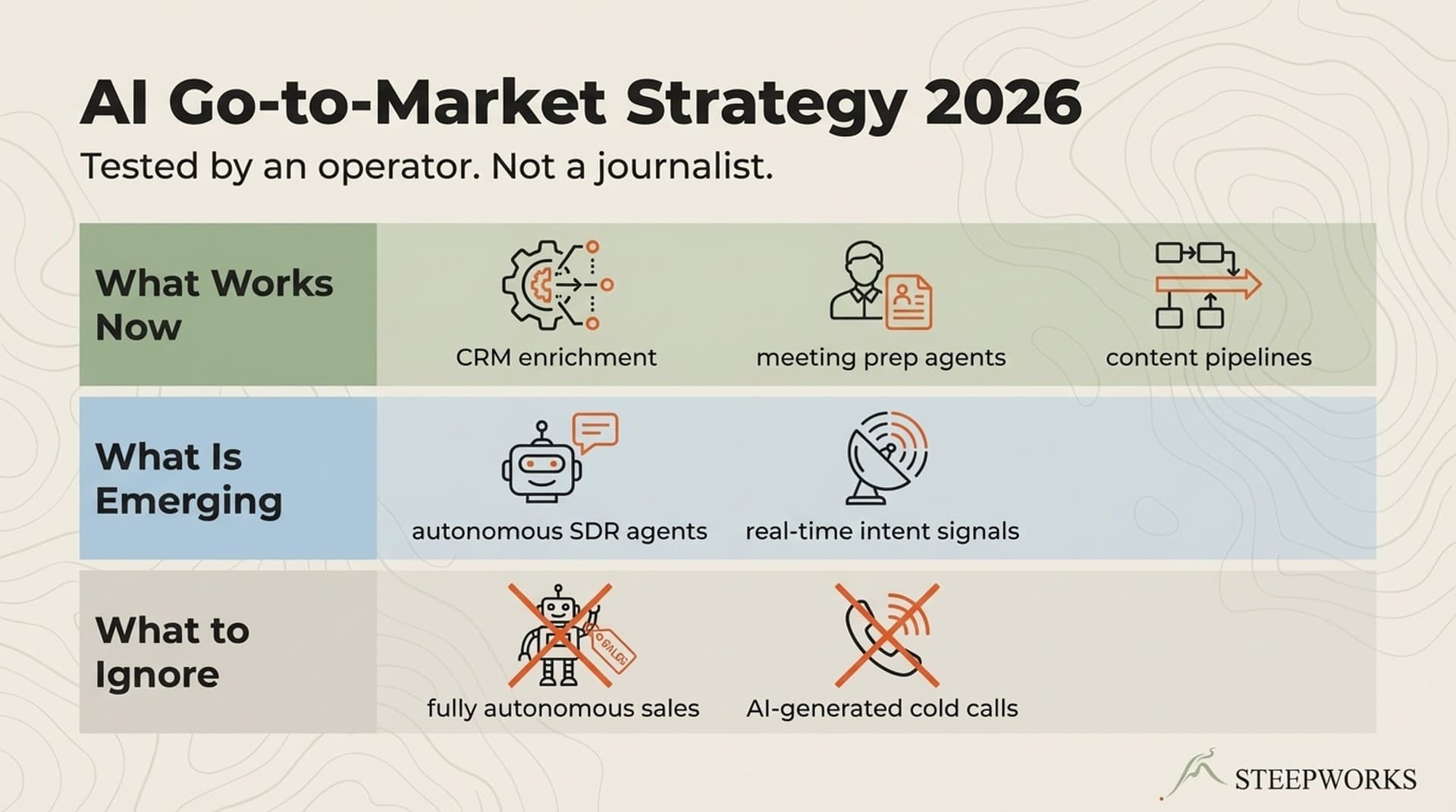
Highest ROI. Not glamorous. Not what vendors demo at conferences. Compounds week over week. Start here.
Meeting Prep Dossiers
Before every external meeting, an AI system pulls CRM history, company news, competitive signals, LinkedIn activity, and synthesizes a one-page brief. Built version one in two weeks. Iterated for three months. Running in production 18+ months.
Prep time dropped from 45 minutes to 10. But the quality went up -- I catch signals I'd miss: a prospect's company just lost their VP Engineering, a competitor launched a feature that undercuts our positioning. Those details change how you open a conversation.
The hidden value: meeting prep creates a forcing function for CRM hygiene. Stale CRM data means a stale dossier, and you notice immediately. This single system drives more data quality improvement than any "please update your records" message.
Build estimate: RevOps lead, two to three weeks, using Clay or Make plus your CRM. No developer required.
ICP Scoring and Enrichment
Takes a target account list, enriches with firmographic, technographic, and intent signals, then scores against validated ICP criteria. I built an ICP from scratch for a PE-backed manufacturer using this approach -- the AI accelerated research by 10x without replacing the strategic judgment about who to target.
The key: scoring criteria come from human analysis of closed-won patterns. Best 20 customers, common traits, encoded as rules, AI applies at scale. The AI doesn't know what a good customer looks like. You do.
Build estimate: VP Marketing defines criteria, RevOps or GTM engineer builds the pipeline. Three to four weeks. Enrichment data runs $200-$500/month.
Competitive Intelligence Synthesis
Monitors competitor positioning, pricing updates, feature launches. Weekly brief I review Monday mornings.
AI is excellent at detecting changes and summarizing them. Terrible at interpreting what they mean. A competitor drops price 20% -- the AI tells me. Whether that signals panic, a market entry play, or an accounting decision requires context the AI doesn't have.
Build estimate: Marketing ops, one week. Low cost, high signal-to-noise once you tune sources.
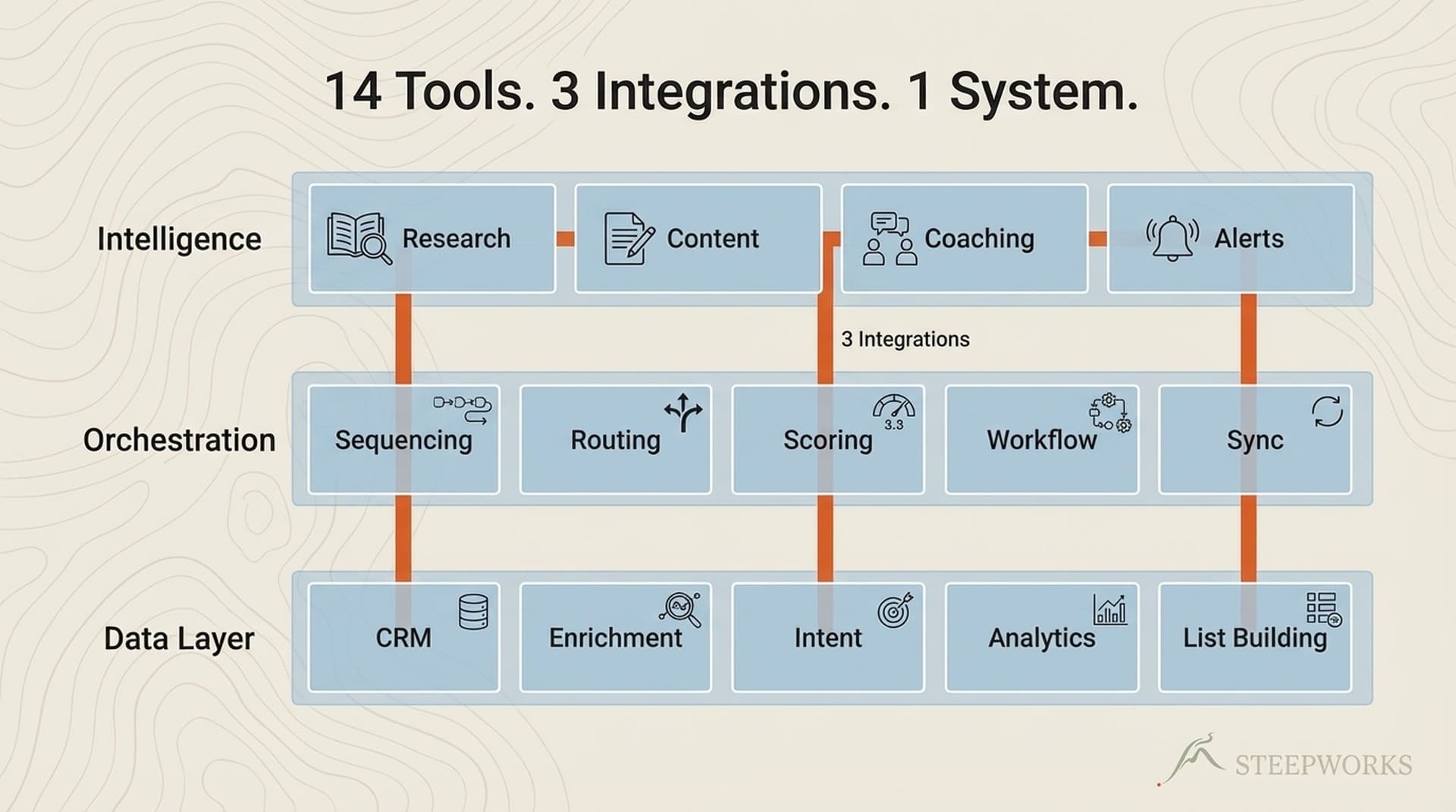
For the full stack, see the AI GTM stack I run in production.
What's Working: Content Operations at Scale
Content is where AI earns its keep -- but only with the right architecture. This isn't "AI writes your blog posts." It's "AI turns a three-person content operation into something one operator can run at higher quality."
Multi-Agent Content Curation
I run a 7-agent system that sources, classifies, curates, and drafts newsletter content. Each agent has a specific role -- scout, classifier, curator, writer, editor -- with structured review gates between steps. Not one prompt trying to do everything.
Three months to build, six months running weekly. Newsletter production time dropped from 8+ hours to under 2. Curation quality improved because scout agents catch sources I'd miss.
Single-agent content generation produces slop. I've tested it extensively. Multi-agent pipelines with review gates produce publishable drafts. Architecture matters more than the model.
Build estimate: Advanced. Requires someone comfortable orchestrating AI workflows.
Case Study and Demand Gen Pipeline
Same multi-agent pattern: one agent structures raw customer quotes, one drafts narrative, one edits for brand voice, one formats for channels.
For a 10-to-15-person marketing team, this is where leverage is real. Content manager defines the brief, pipeline produces a first draft in two hours instead of two weeks. Same quality, 5x throughput.
SEO Content Pipeline
Systematic production -- keyword research, outline generation, draft, editorial review, publication. I've produced 1,000+ SEO pages through a structured pipeline with automated quality checks before human review.
Don't get me wrong -- AI drafts still need human editing. Every time. The gain is in research, structuring, and first-draft speed. Anyone saying otherwise isn't checking their quality.
Quality Gates Are Non-Negotiable
Every piece passes human review before publication. No exceptions. I've never published AI content without human review, and I never will.
The temptation to skip review grows as volume increases. Resist it. The moment you publish unreviewed AI content, your brand takes a hit you won't notice for six months -- when someone screenshots a hallucinated stat and posts it on LinkedIn.
What's Working: Infrastructure Nobody Talks About
No conference talks about this. No vendor demos it. Most reliable ROI lives here.
Data Pipeline Automation
Event scraping, classification, deduplication pipelines on schedule. Cloudflare Workers plus Supabase plus scheduled scripts. Idempotent, fail-graceful, logs everything.
Freed 5-10 hours per week of manual processing. That's 250+ hours a year on higher-value work.
Knowledge Architecture
The most underrated investment.
Lightweight version (start here): Five pages -- ICP definition, positioning, competitive landscape, brand voice, key proof points. Feed this to any AI tool as context and every output improves. Takes an afternoon.
Advanced version: I've built this into a 300+ file operational system -- skills, workflows, context files for every task. Months of investment. Same principle at both scales: structured context makes every AI tool smarter.
Why this matters more than tool selection: Two teams using the same tool get wildly different results if one has structured context and the other prompts from scratch. The context layer is the moat.
What Doesn't Work (Yet)
Fully Autonomous Outbound
Open rates look promising for two to three weeks. Reply quality drops. The personalization reads as templated. Every prospect gets the same "I noticed your company just..." emails from a dozen AI tools. Signal becomes noise.
Current state of the art: AI drafts, human edits heavily. ~40% time reduction vs. writing from scratch. But "set it and send it" isn't viable for B2B outbound targeting senior buyers.
Why: good outbound requires reading between the lines. AI gathers the lines -- funding round, job posting, product launch. It can't sense that a VP Marketing posting about "operational efficiency" after layoffs signals something different than the same phrase after a Series C.
Replacing Human Judgment in Deal Strategy
I've tried pipeline forecasting, deal scoring, next-best-action recommendations. Models are only as good as CRM data, which is never as clean as the vendor demo.
Where it helps: flagging 14-day-stale deals. Pattern matching against close rates. Basic hygiene alerts. Valuable because they catch things humans forget, not because they predict things humans can't see.
Where it fails: predicting which deals close. Understanding buyer politics. Knowing when a champion is losing internal support.
"Set and Forget" Automation
Every AI system I've built requires monitoring. Every one. The ones I stopped watching quietly degraded.
A content scraping pipeline stopped surfacing results from a key source for three weeks because the site redesigned. The scraper ran without errors -- just returned empty results. Nobody noticed until a reader asked. Silent failures are everywhere in AI systems.
Model outputs drift. Data sources go stale. API limits change. AI doesn't eliminate operational overhead -- it changes its shape. Less time on repetitive tasks, more time monitoring. Good trade, but not the trade vendors sell.
Adoption test: Before building any AI system, shadow the person who'll use it. Build into their existing flow, not beside it.
The Three-Layer Framework
After 2.5 years, here's how I decide which AI investments to make.
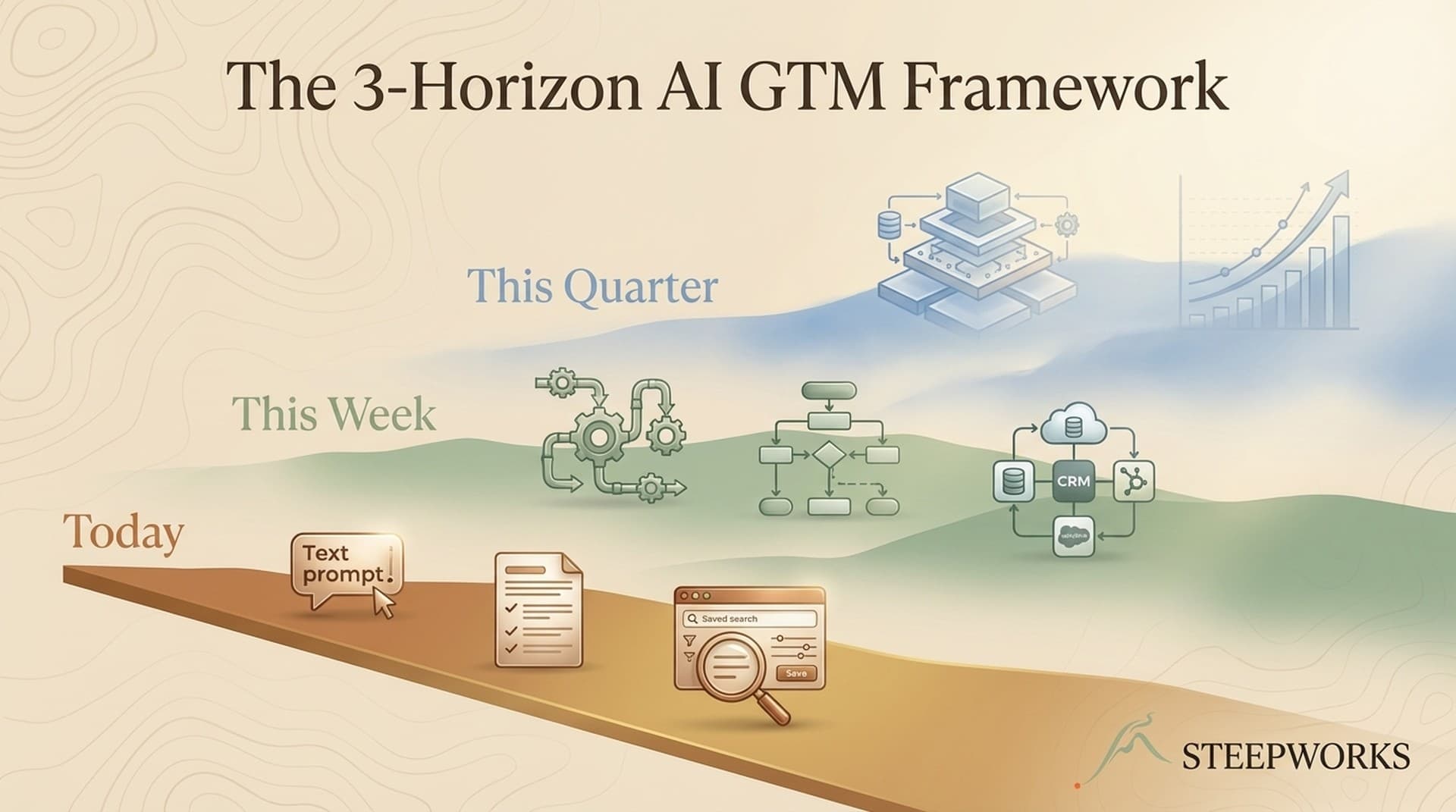
Layer 1: Research and Intelligence -- Deploy Now
Meeting prep, ICP enrichment, competitive monitoring. Highest ROI, lowest risk, compounds over time.
Time to value: two to four weeks to build, measurable impact by week six. This is your 30-day win. When your CEO asks "what are we doing with AI?" show meeting prep dossiers in week three. That buys credibility for the deeper work.
Estimate: RevOps lead, two weeks part-time. 120 hours reclaimed per person per year (30 min/meeting, 5 meetings/week, 48 weeks).
Layer 2: Content and Operations -- Deploy This Quarter
Content pipelines, data automation, SEO infrastructure. Higher build cost, but it scales a small team dramatically. A 12-person marketing team can produce 3x content volume without hiring.
Time to value: one to three months to build, full ROI by month four to six.
Estimate: Content lead plus GTM engineer, six to eight weeks.
Layer 3: Agentic Workflows -- Experiment Carefully
Multi-step autonomous workflows, persistent monitoring agents. The frontier.
The tooling is maturing but not mature. I've built agentic systems that run for weeks. I've built ones that failed in ways I didn't anticipate.
Honest take: I'm building these now. Some are promising. None are stable enough to bet revenue on without human fallbacks.
Estimate: Dedicated GTM engineer or developer. Not a side project.
Decision filter for any layer: Does this augment judgment or replace it? If augment, build. If replace, wait -- or at minimum, keep a human in the loop for months, not weeks.
What I'd Tell My 2024 Self
Start with research, not outbound. Everyone wants AI to write cold emails. ROI is faster and more durable in meeting prep. Start there.
Build the context layer first. Before connecting any tool, write down your ICP, positioning, competitive landscape, brand voice. Even five pages transforms every prompt from generic to specific. Without context, AI is fast and wrong. With context, fast and useful.
Multi-agent beats single-agent. One AI doing everything produces mediocre everything. Specialized agents with clear handoffs produce quality. If you're getting bad output, the fix usually isn't a better prompt -- it's decomposing the task with review gates between steps.
Show a quick win, then build for compounding. CEO wants results in 30 days. Meeting prep delivers in week two. Show that. Use the credibility to build the content pipeline that pays off in month six.
Keep humans in the loop longer than you think necessary. The temptation to remove review gates grows as confidence grows. I've never regretted keeping a human check. I have regretted removing one too early.
AI go-to-market strategy in 2026 isn't about picking the right tools. It's about knowing which problems deserve AI and which deserve your attention. After 2.5 years: AI does the prep, you make the calls.
Approaches like this are part of a broader AI GTM strategy — where systems replace manual repetition across the go-to-market stack.